A Late-Autumn Garden Visit for Shape and Structure
A late-autumn garden visit reveals how silhouettes, paths, and bed outlines hold a garden together after flowers fade, with a simple route for looking closely.
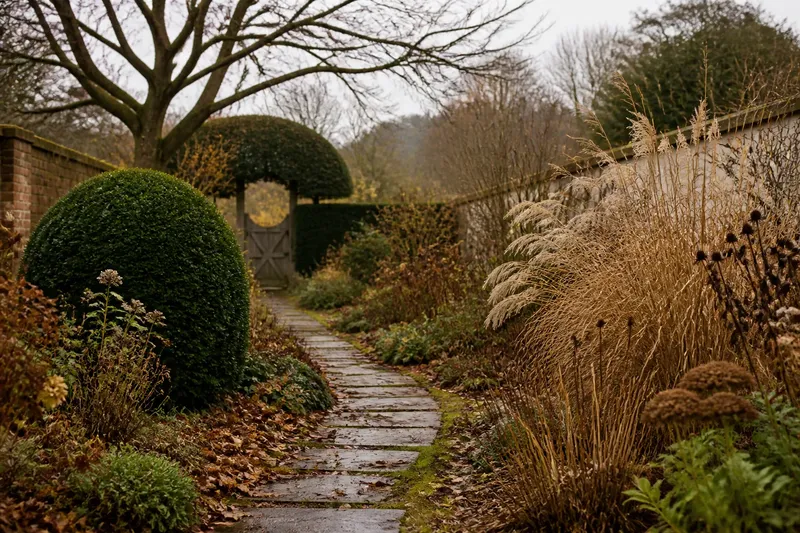
How do you read a garden after its flowers and autumn color have faded? A late-autumn garden visit can show which shapes still hold the space together: bare branches, seed heads, clipped forms, and the lines between paths and beds. Follow a steady route and pause to notice how those outlines guide your eye.
Choose a clear route
Pick a route that crosses more than one kind of space without doubling back. Begin at the gate or your usual entrance, continue along the main path, and finish where you can see several beds at once. The aim is not to cover every corner, but to notice how the garden’s shapes change as you move.
Choose a dry day if possible, when leaves are less likely to stick across the path. Bring a small notebook and pencil, and make a first pass without taking photos. A camera can record a view; looking without framing a photograph helps you notice what sits at its edges.
At each pause, look from near to far: first at the ground and bed edge, then at the middle distance, then at the tallest silhouettes. This order helps separate the lines that make a garden legible from details that briefly catch your attention.
Read the threshold
Stop at the entrance before walking in. Notice the first outline your eye meets. It might be a hedge, a tree arch, a low wall, or the edge of a planting bed. Ask whether that outline makes the garden feel open, enclosed, or divided into smaller views.
Look for the route through the space. Does the path read clearly from the threshold, or only after you take a few steps? Does its edge hold a steady line, or do leaves and spreading plants blur it? You are observing how the route directs attention, not judging whether it is attractive.
Look up as well as down. A bare tree may frame a plain entrance, while crossing branches may make the view feel busy. Notice where upper shapes overlap buildings, fences, or distant trees. Those relationships remain visible after individual blooms have gone.
Follow the ground lines
Walk slowly and watch the boundary beside the path. A clear edge can make a bed look composed even when its plants are dormant. Where the boundary disappears, look for the cause: fallen leaves, grass leaning over the path, a spreading plant, or a change in surface.
Compare the line of the path with the line of the bed. They may run in parallel, meet at an angle, or pull apart to open a small pocket of space. A path that narrows between planting may make a distant tree feel like a destination; a broad opening may make the whole bed easier to see.
Do not treat every soft edge as a problem. Fallen leaves can make a border look natural, and grasses or seed heads may lean into a path as part of their seasonal character. The useful question is whether you can still tell where to walk and where the planting begins. Think of the path edge as a coat hem: relaxed is fine, but its outline should still be readable.
Read bare silhouettes
At a bend or junction, pause and turn toward the entrance. Reversing your view may reveal a shrub that closes the scene, a low evergreen anchoring a corner, or a gap between branches framing the path.
Notice the difference between solid and open forms. A dense evergreen mass can steady a view; airy stems can let a wall or another plant show through. Tall ornamental grasses and standing seed heads add fine lines, while a clipped hedge or rounded shrub supplies a continuous outline. Contrasting shapes can make the garden’s structure easier to read.
Check how a prominent plant relates to its surroundings. A small tree may stand out against a fence or disappear into a similar background. A pale stem may show against an evergreen but vanish against a light wall. These are observations about placement and contrast, not reasons by themselves to remove a plant.
What should you notice?
How do I see the garden without flowers?
Look for repeated outlines: rounded shrubs, upright stems, or a recurring curve in the bed edge. Then notice where a different form interrupts the pattern. Repetition gives the view rhythm; a distinct silhouette gives your eye somewhere to pause.
Should I cut back every seed head?
No single approach suits every plant or garden. Note which standing stems contribute visible shape and which have collapsed or obscured a route, then make a separate maintenance decision. For timing and care, consult plant-specific guidance from a reliable horticultural source or your local extension service; a qualified local gardening professional can help with questions about a particular plant.
What makes a path easy to read?
A path is easier to follow when its direction and edges remain apparent from places where you enter, turn, or choose between routes. Look for spots where a bed spills across the walking line or the surface blends visually with its surroundings. Record the location rather than deciding on an immediate redesign.
How can I keep useful notes?
Write down a location and one visible detail, such as “east bend: grass hides the bed edge” or “gate view: tree frames the path.” Add a quick sketch if two outlines overlap in a way that is hard to describe. Specific notes help you remember what you saw rather than relying on a general impression.
Imagine a small garden
Say you have a compact back garden with a narrow path, a rounded evergreen near the gate, and dormant ornamental grass beside the far bed. On a late-autumn visit, you start at the gate and find that fallen leaves cover the path’s edge while the grass leans into the walking space. The evergreen remains visible, but the far end of the route seems to dissolve into the bed.
You walk to the far end, turn around, and see that the evergreen frames the entrance well. The path is clear underfoot, but leaves make its outline difficult to distinguish. You note both observations. After the visit, you clear only the section that obscures the route and consult plant-specific or local horticultural guidance before deciding when or whether the grass needs maintenance.
The expected visible result is modest and easy to check: the walking line becomes more legible while the grass keeps its upright winter shape. The visit has separated two concerns—an unclear path edge and a plant that contributes structure—so one does not automatically lead to removing the other.
Finish with a whole view
At the end of the route, choose a place where you can see several parts of the garden together. Look for a clear sequence: an entrance shape, a path line, and plant outlines that hold the view. Then notice where the sequence breaks. A bare patch may be a deliberate opening, or it may be a gap that becomes obvious only after surrounding foliage recedes.
Use your notes to distinguish a seasonal feature from a structural concern. A seed head that stands clearly today may flatten in wet weather; a path boundary that disappears under leaves may call for a small change in maintenance. Avoid making a permanent planting decision from one quiet afternoon alone. The late-autumn view shows what remains visible, not the entire character of a garden in every season.
On your next late-autumn garden visit, keep the same route and compare what has changed: which silhouettes persist, where the path reads clearly, and whether bed outlines make sense from the entrance. That repeated look creates a practical record. Preserve forms that help the garden hold its shape, and address the specific edges that make it hard to move through or understand.